
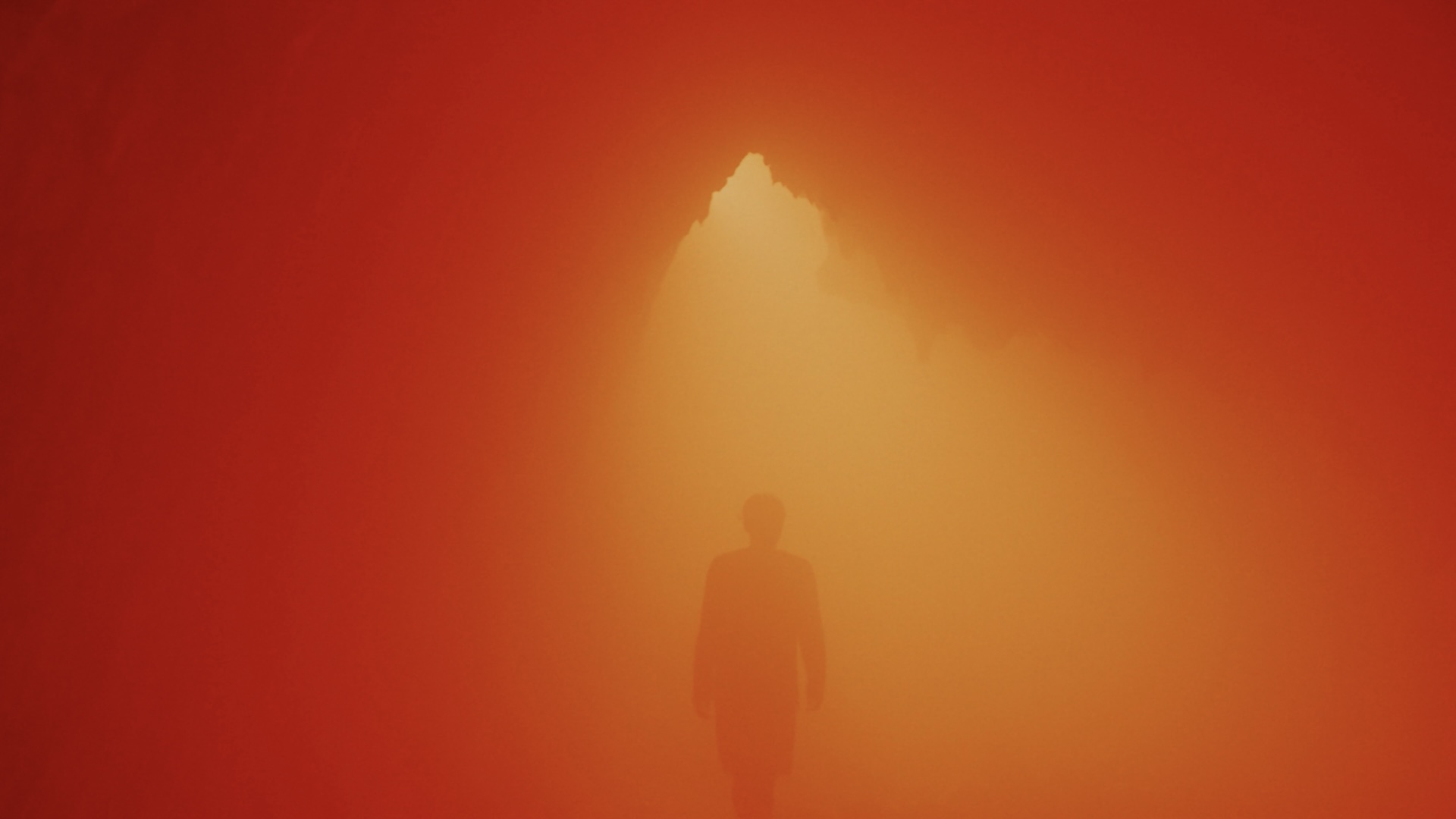
In 1883, the Krakatoa produced what is believed to be the loudest sound ever heard. Its shockwaves circled the globe, while ash transformed skies and sunsets thousands of kilometres away. Carlos Casas takes this eruption, both historical event and living myth, as the point of departure for a story that slips between the nineteenth century, the present and an imagined future.
Kesuma, a young fisherman, lives alone on a bamboo fishing platform near the volcano. After a night in which the fish mysteriously disappear, an eruption and tsunami tear apart his world. Washed onto a remote island, he searches for food and water across scorched shores and dense jungle. As his journey leads inland and underground, the struggle for survival gives way to a descent through geological time and the planet’s unstable interior.
At the centre of the film is Roni Hensilayah, himself a survivor of Krakatoa’s 2018 eruption and tsunami. His physical presence collapses historical and contemporary disaster into a single body, carrying the film between lived experience, speculative fiction and myth.
Krakatoa is less a conventional disaster film than a physical event. Benjamín Echazarreta’s images move from elemental detail to psychedelic rupture, while Academy Award winner Nicolas Becker constructs the film’s geophonic core from seismic recordings, volcanic frequencies and immense subterranean pressure. The image flickers, sound acquires weight, and the cinema itself becomes a resonating chamber.
Join director Carlos Casas for a conversation after the screening about his unique approach to filmmaking.
